
Suffering from back pain that is keeping you awake at night, then try these yoga poses for back pain relief that will help you recover quickly.
These 5 minute yoga for lower back pain can be helpful for busy persons, elderly people and children to relieve back strain quickly without taking any medication or therapy.
According to the World Health Organization approximately 619 to 629 million people are suffering from back issues worldwide, with a projection to increase 843 million by 2050.
These numbers are not that surprising as many people forget to take care of themself because of their busy daily schedules, but this can be solved significantly if you take out 15 minutes time from your daily routine and exercise these asanas for back pain relief.
Now lets learn further and get to know what are these asanas that will help reduce back pain gradually without any need for expensive equipment and memberships.
5 Basic Yoga Poses for Back Pain Relief
Follow these 5 best yoga asanas that will help you relieve your overall back pain including lower back, upper back, and spinal problems.
Child’s Pose (Balasana)

The fundamental resting position of Child’s Pose requires you to kneel down and sit back on your heels while extending your arms forward and touching your forehead to the floor.
The treatment provides lower back and hip and shoulder relief while it calms the body and decreases stress levels.
Cat–Cow Pose (Marjaryasana–Bitilasana)

The Cat–Cow exercise involves gentle movements which people perform on their hands and knees while they transition between two positions that represent a cat and a cow throughout their breathing cycle.
The exercise functions as a spinal warm-up which connects physical movement with breathing patterns to serve as an ideal beginning for all yoga practices.
The treatment improves spinal flexibility and mobility while it reduces back and neck stiffness and establishes a peaceful connection between mind and body.
Downward-Facing Dog (Adho Mukha Svanasana)

Downward-Facing Dog is one of the most recognized yoga poses, where you form an upside-down “V” shape by pressing your hands and feet into the floor while lifting your hips high.
The exercise stretches your hamstring and calf muscles while lengthening your spine and building arm and shoulder strength which improves blood flow and restores your entire body.
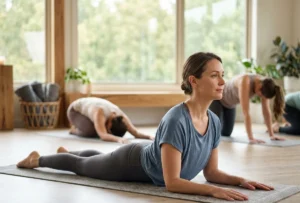
Sphinx Pose (Salamba Bhujangasana)

The Sphinx Pose backbend requires you to rest on your stomach while your forearms support your upper body to create a straight back position which extends through your spine.
The exercise strengthens the spine while opening the chest and lung area to stimulate abdominal organs. The exercise is especially helpful for individuals who work at desks during long office hours.
Supine Twist (Supta Matsyendrasana)

Supine Twist is a relaxing floor pose where you lie on your back, draw one knee to your chest, and gently guide it across your body while keeping both shoulders grounded.
The restorative twist provides deep body relief which practitioners use to unwind their bodies after yoga practice or bedtime.
The treatment reduces tension from the spine, hips and outer thighs while it helps digestion and calms the nervous system to produce a state of deep relaxation.
Things to Keep in Mind Before Practicing Yoga for Back Strain
These 6 things you must keep in your mind before practicing any type of yoga or especially back pain related yoga.
-
- You must first obtain an accurate diagnosis to confirm whether your back pain results from a muscle strain or a more severe spinal condition.
-
- Begin your practice with Hatha Yoga and Restorative Yoga which offer gentle yoga styles that emphasize slow and controlled movement.
-
- The initial period requires you to stay away from deep forward bends and intense twists because these movements will make your back strain muscles worse.
-
- Your recovery from back pain will benefit from core and hip muscle strengthening exercises because both stability and flexibility are essential for your healing process.
-
- The poses require you to maintain a neutral spine position which helps prevent extra pressure on your injured body part.
-
- You must stop all activities when you experience sharp or shooting or worsening pain and you should only begin to move forward when your back has fully recovered.
The Bottom Line
Recovering from back issues is not a very complex process until and unless it’s a major back problem that requires medical attention. By following these yoga exercises for lower back pain you can easily tackle minor back issues without having to spend money on therapy sessions, hospitals, or any medical related equipment.
FAQs: Yoga For Back Pain
Which is the most suitable yoga for back pain relief?
Hatha yoga is considered one of the most suitable asanas for back pain recovery because its slow and controlled movements provide instant relief.
How to remove back pain in under 5 minutes?
Try doing child pose or cat-cow pose for a few minutes, they can immediately decompress the spine and release build-up tension from the back.
Can beginners practice yoga for back pain or injury?
Yes, beginners can also practice back pain relief yoga, they can start with basic exercise and try avoiding complex poses for any further injury.
How can I heal my lower back pain quickly?
You need to practice the Sphinx pose or Pelvic Tilts, they can help realign the spine and soothe lower back inflammation fast.
What are some of the best back pain exercises for busy people?
Standing forward folds and seated spin twist are quick and easy exercises to relieve back pain instantly, they are very helpful for busy persons who sit for a long period of time in a chair.
Is yoga for back pain healing good for elderly people?
Yes, yoga is good for elderly people as well, as it improves flexibility and balance, though chair yoga is often considered as very safe.
Can yoga strengthen back muscles?
Yoga helps build significant core and back strength by using your own body weight using poses like plank or Bird-Dog.